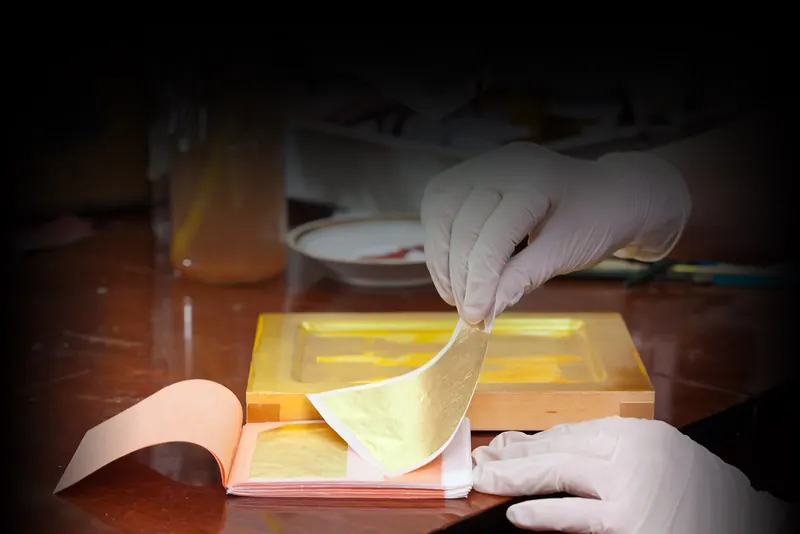
Gold has decorated food for centuries, from medieval banquets to the wedding cakes and chocolates of today. Used correctly, it is one of the most striking finishes a chef can apply, and one of the simplest.
What makes gold edible
Gold is chemically inert: it does not react with food or with the body, and it passes through without being absorbed. Edible gold is high-carat gold, typically 22 to 24 carats, beaten into leaves only a fraction of a micron thick. It has no taste and no texture; its role is purely visual.
The E175 code
In the European Union, gold is an authorised food additive under the code E175, and silver under E174. Their use is permitted for the external decoration of products such as confectionery, chocolates and certain drinks. Professional buyers should always check that the product is sold specifically as edible, with its food-grade certification, rather than gilding gold intended for decorative art.
Leaf, flakes and glitter
- Gold leaf — full sheets, sold in books, for covering cakes, chocolates and plated desserts.
- Flakes — irregular fragments for scattering on pastries, chocolates, cocktails and fine-dining dishes.
- Glitter — very fine particles for a delicate shimmer on macarons, pralines and finishing touches.
Best practice in the kitchen
- Work in a draught-free space with dry hands and tools: gold leaf is so light that a breath can lift it.
- Use a soft brush, a gilder's knife or fine tweezers rather than fingers.
- Apply gold to a slightly tacky surface, such as a glaze or a lightly moistened area, so that it adheres.
- Store gold in its book or jar, closed and dry, away from humidity.
Nena Edible Gold is the exclusive importer of Charrier edible gold in Iran. Charrier's edible gold leaf, flakes and glitter are 23 carats and certified under E175.