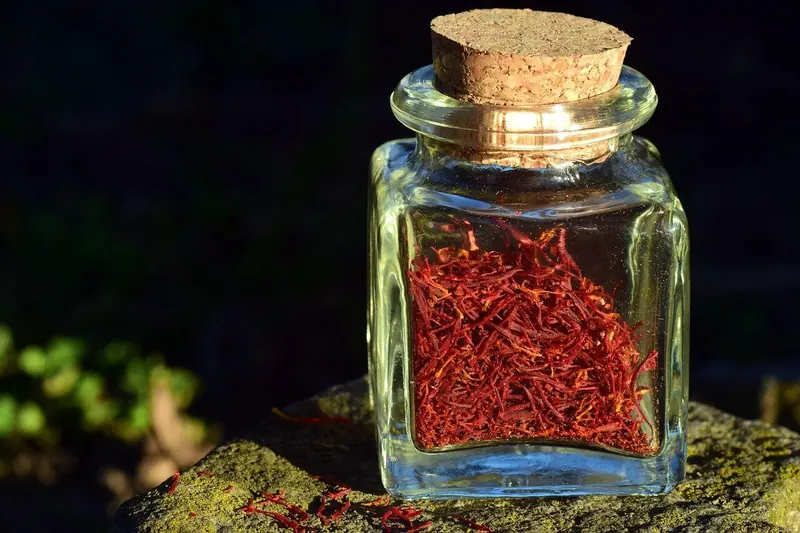
Saffron is the most valuable spice in the world by weight, and Iran grows the large majority of it. Yet for many buyers the market can seem opaque: the same word, saffron, covers products whose colour strength, aroma and price differ several times over. Two tools make sense of it: the traditional Iranian grade names, which describe how the threads are cut, and the international standard ISO 3632, which measures what is inside them.
The Iranian grade names
Iranian grades describe which part of the flower ends up in the jar. Each crocus flower carries three crimson stigmas joined to a pale yellow style. The more carefully the red stigma is separated from the yellow style, the higher the grade.
- Super Negin — long, thick, entirely red stigmas, cut and separated. The most refined and most expensive presentation.
- Negin — entirely red stigmas with excellent colour strength, slightly less uniform than Super Negin.
- Sargol — the red tips of the stigma only, with no yellow style. Intense colour at an accessible price.
- Pushal — red stigmas with a small part of the yellow style attached. Widely used by the food industry.
- Bunch (Dasteh) — whole threads, stigma and style, tied in bunches. The traditional presentation.
What ISO 3632 measures
The grade name tells you how saffron looks; laboratory analysis tells you how it performs. ISO 3632 measures three compounds by spectrophotometry: crocin, which gives colour; picrocrocin, which gives the characteristic bitter-honey taste; and safranal, which gives aroma. It also sets limits for moisture and foreign matter, and classifies saffron into categories, Category I being the highest.
Colour strength is the figure buyers watch most closely: the higher the crocin reading, the more colour a given weight of saffron delivers. The best Iranian Negin and Sargol sit comfortably in Category I.
How to buy with confidence
- Ask for a certificate of analysis for each batch, showing crocin, picrocrocin, safranal and moisture.
- Check that threads are dry, brittle and evenly coloured, with no powder or broken fragments at the bottom.
- Be wary of prices far below the market: adulteration with dyed fibres or other flower parts still exists.
- Store saffron in an airtight container, away from light, heat and humidity, to preserve its strength.
At Nena Saffron, every export batch is graded and laboratory-tested to ISO 3632 and shipped with its certificate of analysis, so our partners know exactly what they are buying.