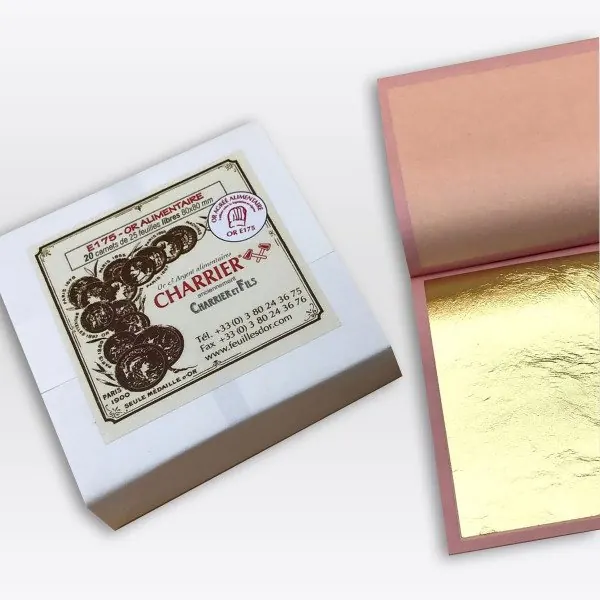
A single leaf of gold is one of the thinnest materials people handle by hand. It is so fine that light passes through it, yet it is made by a craft that has changed little in its principles for centuries: goldbeating. Understanding how leaf is made explains both its delicacy in the kitchen and why quality varies from one producer to another.
From ingot to ribbon
The process starts with gold of a precise purity, sometimes alloyed with a small amount of silver or copper to adjust its colour and working properties. The metal is melted, cast into a small ingot and then passed repeatedly through rolling mills until it becomes a long, thin ribbon. The ribbon is cut into small squares, ready for beating.
The beating
The squares are stacked between interleaving sheets to form a packet, which is beaten in several stages, by hand or with mechanical hammers. After each stage the gold, now much larger and thinner, is cut again and placed in a new packet. At the end, a leaf is around a ten-thousandth of a millimetre thick: thinner than the wavelength of visible light, which is why it glows green-blue when held up to a lamp.
This last step demands great skill. Uneven beating leaves holes, thick patches or a dull surface, so the finest producers inspect leaves one by one before they are trimmed to size.
Into the book
The finished leaves are too fragile to touch. Using a wooden pincer or a gilder's knife, they are lifted onto a leather cushion, cut square and laid between sheets of tissue paper to form a book, most often of 25 leaves. The paper protects each leaf and allows it to be taken out one at a time.
Loose leaf or transfer leaf?
Gold leaf for food is sold in two main forms, and choosing the right one makes a real difference in the kitchen.
- Loose leaf — the leaf rests freely between the pages of the book. It follows curves and irregular shapes beautifully and can be torn into pieces, but it needs a still room, dry hands and practice, as the slightest breath lifts it.
- Transfer leaf — the leaf is lightly attached to a sheet of tissue paper. It is pressed onto the surface and the paper is peeled away, which makes it much easier to apply on flat or gently curved surfaces such as glazes, chocolate bars and cake sides.
For full coverage of an entremets or a chocolate, many professionals use transfer leaf; for decorating fruit, truffles or plated desserts with irregular shapes, loose leaf or flakes are often easier.
Judging quality
- Purity and colour — edible leaf is high-carat gold, typically 22 to 24 carats, with a warm, even colour.
- Surface — bright and uniform, without holes, tears, wrinkles or dull patches.
- Regular size — leaves cut cleanly to the same dimensions throughout the book.
- Food compliance — labelled as edible, with the additive code E175 for gold or E174 for silver where required, and traceable lot numbers.
Storing and handling
- Keep books flat and closed, in a dry place at room temperature, away from draughts and humidity.
- Work in a still room, away from fans and open windows, with clean, dry tools.
- Use a soft brush or a gilder's knife rather than fingers, which make the leaf stick and tear.
- Apply leaf to a slightly tacky surface, such as fresh glaze or chocolate, so it adheres without glue.
Nena Edible Gold is the exclusive importer of Charrier edible gold in Iran, supplying gold and silver leaf, flakes and glitter to pastry chefs, chocolatiers, hotels and food brands.