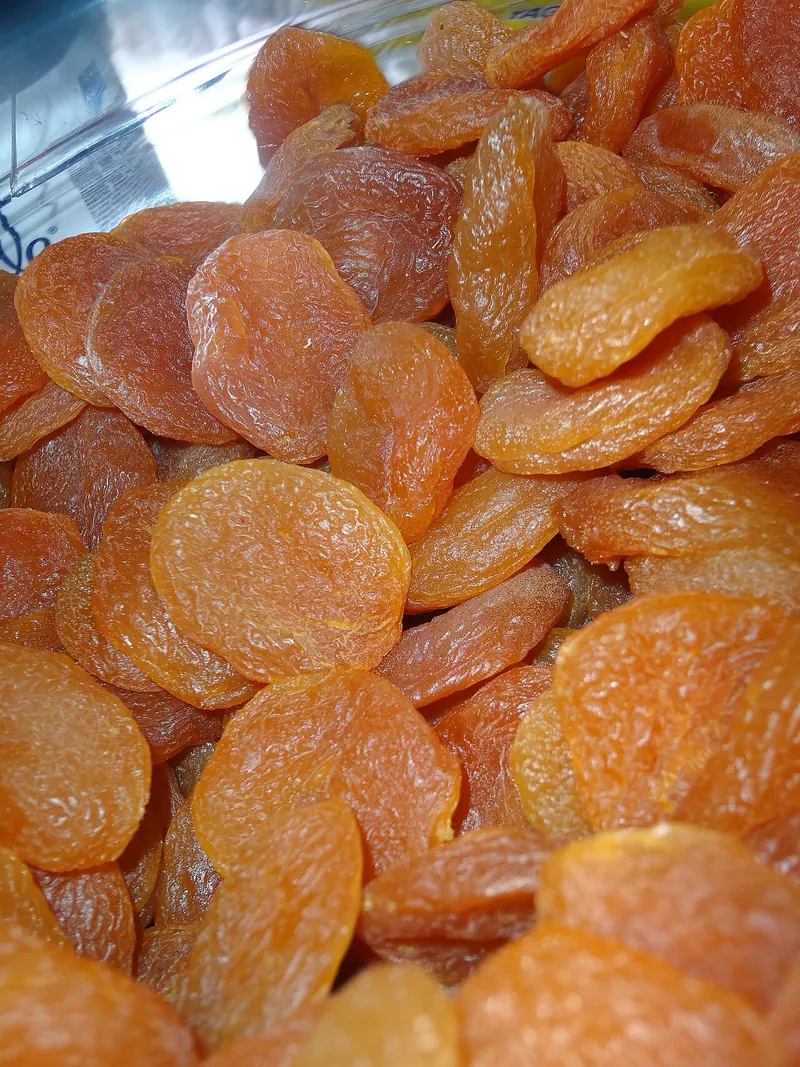
Beyond pistachios and dates, Iran is a major source of dried fruit. Two products stand out for international buyers: raisins, made from the grapes of the country's north-west and north-east, and barberries, a tart red berry that Iran produces on a scale no other country matches. Both are simple products, but their quality depends heavily on how they are dried, cleaned and stored.
Where they come from
Iranian raisins come mainly from the vineyards of Hamadan province, around Malayer, from Qazvin and Takestan, from West Azerbaijan around Urmia, and from Khorasan, where the town of Kashmar is known for its green raisins. Barberries are grown almost entirely in South Khorasan, around Qaen and Birjand, where seedless barberry shrubs have been cultivated for generations on dry, high-altitude land.
Types of raisins
- Golden raisins — light-coloured raisins treated with sulphur dioxide to keep their colour, then dried in the shade or by machine.
- Green raisins — shade-dried raisins with a greenish tone and a delicate taste, a speciality of Khorasan.
- Sun-dried raisins — dried naturally in the sun, which gives them a dark brown colour and a deeper, caramel flavour.
- Sultana-type raisins — seedless raisins, often lightly coated with vegetable oil to keep them free-flowing.
Barberries: Iran's ruby-red export
Dried barberries, known in Iran as zereshk, are small, sour berries used in rice dishes, stews, salads and baking. They are harvested in autumn, when whole branches are cut and the berries are dried before being separated from the stems. Drying in the shade keeps a bright red colour that buyers prize; drying in direct sun is faster but gives a darker berry with a lower price.
Because their colour fades with heat and light, dried barberries keep best in cool, dark conditions, and many distributors store them refrigerated. Colour, cleanliness and the absence of stems are the main signs of quality.
How quality is assessed
- Size and uniformity — for raisins, often expressed as the number of berries per 100 grams.
- Colour — consistent within the lot and typical of the type ordered.
- Moisture — low enough for a long shelf life, but not so low that the fruit becomes hard.
- Cleanliness — free from stems, stones, sand, insects and other foreign matter, usually after washing and machine sorting.
- Residues and contaminants — sulphur dioxide in golden raisins and ochratoxin A in all dried vine fruit are regulated in many markets, so laboratory tests should match the destination's limits.
Packing and shipping
Dried fruit for export is usually packed in cartons lined with food-grade polyethylene, or in smaller retail packs for supermarkets and private labels. It travels in dry containers by sea; refrigerated containers are used when long, hot journeys could affect colour or quality. Raisins are classified under HS code 0806.20.
What to specify in a contract
- Product type, variety, origin and crop year.
- Size or count, colour, moisture and tolerances for defects and foreign matter.
- Treatment: sulphured or unsulphured, oiled or unoiled, washed and sorted.
- Packaging, labelling and private-label requirements.
- Laboratory analysis, independent pre-shipment inspection, Incoterms and the certificates required at destination.
Nena Food Trading sources raisins, barberries and other dried fruit directly from producers in Iran's main growing regions, with pre-shipment inspection and full traceability for every lot.